





I’m plotting a new WIP, teetering in that sweet spot where what I’m embarking on is absolutely, positively, definitely going to be the best thing EVER. That usually lasts about thirty seconds. Because the next thing I have to do is sit myself down for the talk. You know: the TALK. Is this an idea? Do I really want to spend a year writing and rewriting, editing and polishing it? Is it going to have sales potential? What’s in it for the reader? What makes it different enough from everything else that’s out there?
Those are tough questions, but I already know my characters and my concept. I’ve got a one-line pitch, a two-sentence pitch, and a paragraph-long synopsis of the storyline. So my answers are pretty good this time. The idea doesn’t want to die.
Which means I can go on to the next step.
I’m in awe of the pantsers out there. Me? I need a road map. Heck, I need to call Destination Assist. As much as I’m a pantser wanna-be, I still I need Turning Points, and Character Worksheets, and well, you get the picture. The more I write and edit and read and study craft, the more I’m convinced that a great novel is made before you sit down to do the writing or maybe even the outlining.
I started sifting through all the great advice I’ve read or heard, making notes to help in the planning stages. The next thing I knew I had a long series of questions to ask myself. This is what I’m kicking around now as I start to formalize my turning points and story beats.
- How can I make the protagonist likeable or at least relatable?
- Are both the protagonist and the antagonist extraordinary in some way?
- Do they both care passionately about something?
- Is what they care about at the heart of their opposition?
- Is the antagonist just as strong or even stronger than the protagonist and just as compelling or intriguing?
- Do all the main characters have genuine flaws and eccentricities?
- Is there opposition between what the protagonist wants, her external goal, and what she needs, her internal goal?
- Is the protag going to experience a change of fortune: from good fortune to bad, from bad fortune to good, from good to bad to good, from bad to good to bad?
- How can I use the setting and season to make the situation worse for the protag?
- How can I make the setting more interesting and challenging?
- Are the protag and antag struggling within a situation readers haven’t seen before?
- How can I elevate the concept?
- What extra coolness factor can I add?
- What twist can I add to make this unusual?
- Are there logical connections between characters, plot, and theme(s)?
- Is the theme universal?
- Does the protag’s struggle exploit a universal fear?
- Are there high stakes–terrible consequences–if the protag fails?
- Does she have to make an impossible choice or sacrifice that will make her pay personally before she can win against the antag?
- How can I provide a test at the beginning of the manuscript to show off the trait the protag needs to change before she can win?
- What makes her the way she is, and how can I show that to make her initial failure understandable and relatable?
- How can I make the stakes even higher at every turning point while keeping them relatable?
- Have I got enough of a coolness or fun factor in the mid section to sell the premise and carry the second act?
- How do I keep the protag in conflict between two emotions so she has to fight to resolve her feelings?
- How can I exploit the situation and main conflict to force the characters to make active choices?
- How can I limit each of the character’s choices to force them to choose between something bad and something worse, force them into bad decisions, or push them into doing what they least want to do?
- How can I make characters behave in the most unexpected way that fits within their motivation, personality type, and background?
- How do I introduce a new conflict before resolving an existing one?
- What danger can I keep threaten, what information can I promise, what expected emotional crisis, confrontation, loss, or decision can I foreshadow to keep the reader eager to read?
- How can I push an expected outcome into an unexpected direction?
- Before the climax, how do I make it clear why the antagonist is the way he is, and how do I make him sympathetic?
- How can I apply lessons the protag has learned and show her character growth in the climax in a way that will echo the test she failed at the beginning?
- How do I make it clear enough why she has changed enough to choose differently than she did in the initial test?
- Can I make every conflict in a subplot real and hard to overcome?
- How do I resolve all the subplots and weave them together more tightly?
- How do I show the arcs for each of the main characters?
- How do I most smoothly delivere all the missing information before the climax scene?
- How can I the climax the toughest challenge in the manuscript?
- How can I make the resolution truly satisfying?
- How do I make sure I’ve kept my covenant with the reader?
Lots to think about, right? My brain is already popping with plot and scene ideas, and I think (I hope) I’m on to something. As much as I’d love to pants it, I’m afraid I’m the kind of writer who has to feel like I’m funneling my 80,000 words in the right direction before I write instead of trying to squeeze them into shape in revision. Not that I won’t have to do that, too.
What about you? What do you think about before and while you write? What tips have most helped you to elevate your concept or structure?
About the Author
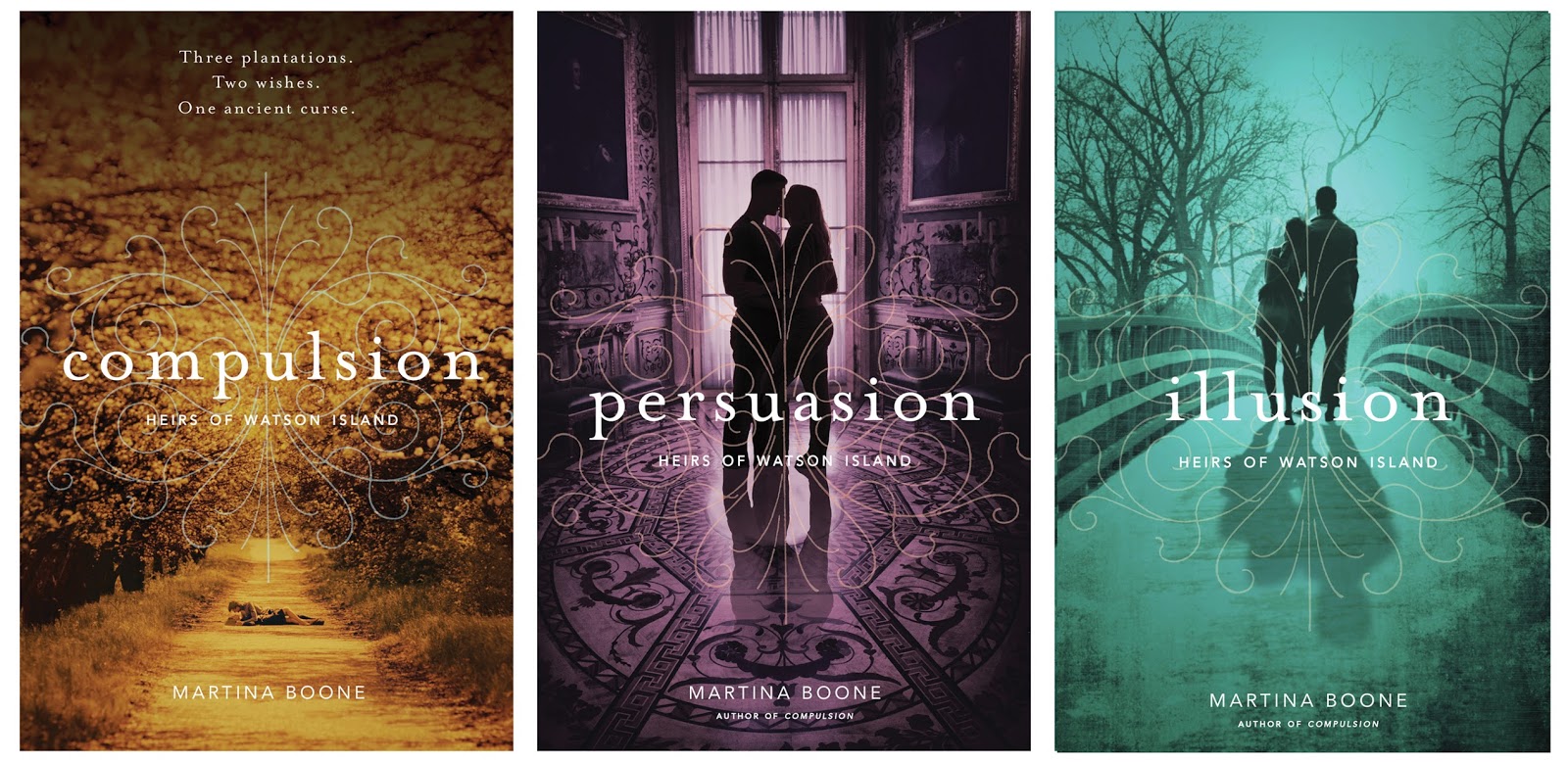 Martina Boone is the author of Compulsion and Persuasion, out now in the romantic Southern Gothic Heirs of Watson Island trilogy from Simon & Schuster, Simon Pulse. Illusion, the final book, will be out in October of 2016. Martina is also the founder of AdventuresInYAPublishing.com, a three-time Writer’s Digest 101 Best Websites for Writers Site, and YASeriesInsiders.com, a site dedicated to encouraging literacy and reader engagement through a celebration of series literature. She’s on the Board of the Literacy Council of Northern Virginia and runs the CompulsionForReading.com program to distribute books to underfunded schools and libraries.


