




So yesterday I was driving home from work and I saw a random shoe on the side of the road. It wasn’t the first time either. Maybe it’s where I live or maybe I’m just weird for noticing this kind of thing, but I swear I see an orphaned shoe like every other week. Construction boots, a child’s sandal, heels, sneakers, flip flops – one time I even saw a walking cast. A WALKING CAST.
Every time I come across this phenomenon, I think – what happened to the other shoe? Who drives and tosses their footwear out the window? I mean, who does that??? Is there a strange shoe cult congregating in Maryland or something?
Anyway, I swear I have a point.
And it’s this – aside from a cluttered closet or a store display, there’s something odd about seeing a single shoe. I mean, they’re supposed to come in pairs. A right. A left. Opposites of each other.
A shoe without its partner is…unbalanced. Lacking of the other. Missing its yin (or yang). This concept of duality isn’t anything new. It goes back forever: Life and Death. Black and white. Sun and moon. Good and Evil. I’m definitely not a philosopher, but when a relationship is weighted heavily to one side or you’re missing a part of the pair, everything else becomes weak and insignificant to the monopoly of the one that is left over. Or something like that, right?
(Just nod your head yes and follow me a sec…)
Duality, opposites, balance, shared responsibility – conceptually, it should be present in your story one way or another. But to better illustrate what I really mean, I’m going to single out the one thematic pair that’s probably the most prevalent in children’s literature:
Love and Hate.
Simply stated, they cannot exist without each other. I wish this weren’t so. One day, it’d be nice for Miss America to get what she’s always longed for. But truth is, if we didn’t have the dirty black streak of hate to spar opposite our purist of purity pure love, then we wouldn’t understand love, and vice versa. It’s an ever-present, ever-dipping scale.
In our stories, we need this contrast – this conflict – to build tension and provide a three-dimensional environment for our characters to play in. If you write a love story that’s all LOVE! LOVE! LOVE!, it would read so sappy, Cheetos would be crying for their cheese back.
In my humble opinion, love and hate are pretty much essential flavors in a good book. And the pairing requires attention to balance and equality, my friends.
Example #1: Romeo and Juliet had this amazing, crazy kind of love, right? But in old Bill Shakes’ story, there was an equally intense hatred between the Capulets and Montagues. TENSION.
Example #2: Katniss wanted to protect her family above all else—even above her own life. But her desire to protect was rivaled by her hatred for the Capitol and all the oppression it represented. CONFLICT.
Example #3: Indiana Jones loved him some adventures, didn’t he? The crazier the locale, the more bad guys he had to fight—the better! So long as there weren’t snakes. But if there were snakes…well, who could forget that scene in Raiders of the Lost Ark with the pyramid full of every slithering reptile known to man? STAKES.
I don’t care how old your protagonist is – five, ten, fifteen, twenty – there must be someone or something he/she loves:
Mom, Dad, brother, sister, friends, boyfriend, girlfriend, teacher, coach, movie star, pet, team, sport, hobby, car, money, school subject, book, video game, food, social status, etc…
And there must be someone or something he or she hates JUST AS MUCH.
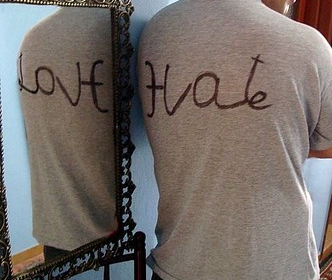
So my tip is this: No matter how much your character favors something or someone, try giving her something equal to dislike. The more matched in significance they are in your character’s mind, the more organic tension we’ll see on the page as your turning points occur and your character struggles to maintain the scale of keeping everything in her life balanced.
So let’s go back to that shoe I saw on the side of the road.
I don’t know where the other pair is. I don’t know why they were separated in the first place. But I know every time I drive that road from now on, I’m gonna be on the lookout for its match.
Tell me, what does your protagonist love? What does he or she hate? Is the degree to which your character views these things matched? How do you pit the two against each other to create tension, conflict, or stakes for your character? Should I leave all this deep thinking to philosophical scholars?
Discuss!
Additional Reading:
Kathy Temean highlights Donald Maas’s tips for creating conflict within your character: https://kathytemean.wordpress.com/2010/12/08/steps-to-create-a-memorable-character/
Genreality on Conflict: http://www.genreality.net/conflict
Danyelle on the QueryTracker Blog talks about villains – and really, you can’t have a villain without a hero! http://querytracker.blogspot.com/2010/12/case-for-villains.html
Happy Pair-Finding!
Cam


