
Adventures in PUPlishing
  • Home
  • Bookworms to Butterflies
  • Main Blog Page
  • Adult
  • Picture Book
  • Young Adult
Select Page
Husky laying down
German Shepard sitting
Black and white spaniel sitting
Big, fuzzing brown puppy sitting
Gray Pitbull sitting
Golden Retriever sitting
Jack Russel sitting
Cocker Spaniel sittting
Young Husky sitting
Hound dog sitting

Untitled Post

by MichelleRae

We’re really excited to feature Abigail Johnson, author of IF I FIX YOU, this week as she shares what made the difference in becoming a published author.

“I decided to talk about critique partner’s and how they were the one thing that made the most difference in getting me from aspiring author to published author”.

I like to think I’ve always been an aspiring author. I wrote little stories as a kid and never really stopped. It wasn’t until college, however, that the idea of becoming a published author took root. That’s when I started writing my very first novel.

You guys, it was such a turd of a book.

It was an adult action-adventure novel with an archaeological bent a la Clive Cussler. I had no idea how to write a novel, much less one that required the obscene amount of research needed for the story I came up with. I spent months and months researching locations and time periods and historical figures who were quasi-connected to my plot. By the time I actually got into writing the story, I had so much info crammed in my head that it strangled the enjoyment for me. I don’t think I made it halfway before I gave up on it.

I didn’t mind though, because while I’ll always get a kick out of reading Dirk Pitt’s latest adventures, my heart will forever belong to YA. There is something endlessly exciting about being a teenager and straddling that line between childhood and adulthood. One I realized that I wanted to write the kind of books I loved reading most—YA—I got an idea for a new story and I could not write it fast enough. There were no tomb robbers or car chases, but there was heartache and first kisses and broken characters. That book would eventually become If I Fix You, my first published—and completed—novel.

Becoming a published author wasn’t as easy as simply finishing a book. I had to rewrite and revise and cut and tear my book apart over and over again before that happened. And I didn’t do it by myself, I couldn’t have done it by myself.

“That all started with Maggie Stiefvater.”

Oh, how I love Maggie Stiefvater. Not just because her writing owns my heart. Every. Single. Time she releases a new book (The Scorpio Races remain my favorite), but because if it weren’t for her, I would never have met the two people most responsible for helping me transition from aspiring author published author.

I’m talking about Maggie Stiefvater’s Critique Partner Love Connection and the two best CP’s on the planet: Sarah Guillory and Kate Goodwin. We were all fans of Maggie’s books and follower’s of her blog when she inaugurated the annual matchup years ago. Maggie invited aspiring authors to share some info about a current WIP in the post comments and then see if anyone seemed interested in swapping pages. We were all writing Contemporary YA and ended up trading a few chapters, and we’ve never looked back.

I was drifting as a writer before I connected with my critique partners. Yes, I had a story and characters I liked, but I didn’t have a book, much less something publishable. I had a draft and a messy one at that. Once we started critiquing for each other, I gained a new focus. For the first time since college, I had people expecting me to write. I had an audience beyond family and friends. I had other writers helping me to identify the strengths and weaknesses in my writing, helping my set–and keep–deadlines, and encouraging me every step of the way. When it came time to start querying agents, they must have read dozens of versions before I sent the first one out. When the inevitable rejections started rolling in, they were the ones who kept me motivated until I landed the perfect agent for me. And you better believe they cheered as loud as anyone when I sold my first book.


We’ve all grown a lot as writers and critique partners since Maggie first “introduced” us, and if anything, I feel like I rely on them more. Beyond reading and critiquing each other’s books, every month we write short stories based on the same prompt and get to try out genres and styles we might never explore as full-length novels. We still brainstorm new ideas, titles and work through plot holes together. We share tips and book recommendations. We help each other with promotion, software, all the other non-book related stuff too. They are, without a doubt, the most invaluable resource I have as a writer and I can’t imagine writing a single word without them. And I love getting to help them too. It’s an incredible feeling to know we’re in this industry together, both as friends and authors.

“[Critique partners] are, without a doubt, the most invaluable resource I have as a writer and I can’t imagine writing a single word without them.”

If you are looking for critique partners to help get you to the next level, a quick search will offer you are a lot of options. If you want to try Maggie Stiefvater’s Critique Partner Love Connection, she’s evolved and streamlined the program into an ongoing Google group here.

ABOUT THE BOOK
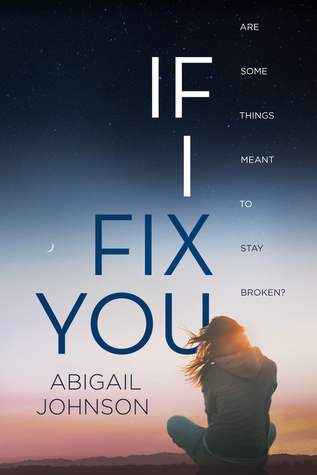
If I Fix You
by Abigail Johnson
Hardcover
Harlequin Teen
Released 10/25/2016


Readers of Sarah Dessen, Cammie McGovern and Morgan Matson will adore this thought-provoking, complex and romantic contemporary novel from debut author Abigail Johnson, about finding the strength to put yourself back together when everything you know has fallen apart.

When sixteen-year-old Jill Whitaker’s mom walks out—with a sticky note as a goodbye—only Jill knows the real reason she’s gone. But how can she tell her father? Jill can hardly believe the truth herself.

Suddenly, the girl who likes to fix things—cars, relationships, romances, people—is all broken up. Used to be, her best friend, tall, blond and hot flirt Sean Addison, could make her smile in seconds. But not anymore. They don’t even talk.

With nothing making sense, Jill tries to pick up the pieces of her life. But when a new guy moves in next door, intense, seriously cute, but with scars—on the inside and out—that he thinks don’t show, Jill finds herself trying to make things better for Daniel. But over one long, hot Arizona summer, she realizes she can’t fix anyone’s life until she fixes her own. And she knows just where to start . . .

View If I Fix You on Goodreads
Purchase If I Fix You at Amazon
Purchase If I Fix You at Indiebound

ABOUT THE AUTHOR

Abigail was born in Pennsylvania. When she was twelve, her family traded in snow storms for year round summers, and moved to Arizona. Abigail chronicled the entire cross-country road trip (in a purple spiral bound notebook that she still has) and has been writing ever since. 

She became a tetraplegic after breaking her neck in a car accident when she was seventeen, but hasn’t let that stop her from bodysurfing in Mexico, writing and directing a high school production of Cinderella, and publishing her first novel.
Website | Goodreads | Twitter | Facebook
 

MichelleRae

Post © MichelleRae and/or Adventures in YA Publishing. All rights reserved.
Posted: Nov 30, 2016
Category: Imported from AYAP
Tags: Inspiration for Writers | WOW Wednesday | Writing Inspiration

Welcome to Transmedia Mutts

Yellow origami dog on a teal background

Unleash your creative bark!

  • Follow
  • Follow
  • Follow
  • Follow

Shout out to AYAP!

Logo for Adventures in YA Publishing

Thank you to the women who started Adventures in YA Publishing and ran it for years. AYAP and TMM have merged to form Adventures in PUPlishing, and the legacy AYAP posts are now part of TMM. Click here to learn more about the earlier AYAP team.


Click to Join our Facebook Group

Share advice, practice pitching, celebrate successes, and support each other through writing and publishing adventures.

← Previous: In Contentious Times, It's Time to Ask for Forgiveness Next: Red Light/Green Light Final Winner! →

The first slide is an animation of a science/magic room in a castle. A cartoon character of a mad-scientist looking man in in the foreground says: “Hello! Dr. Frankenstein here to say, Well Done on kid lit zombie week! I’m an expert at reviving the dead, and let me assure you, with a little spark, you can bring dead projects to life. Especially if you dig up parts from other dead things. I’ll even let you have a sneak peek at my laboratory’s store room to consider potential parts for your dead project. If you see something with a yellow glow, that means you should click it. Have fun!”

He points to the right side of the screen and a new scene slides in of a castle science/magic storage room. There are various cartoon Frankenstein body parts scattered around. Some of them have a yellow glow. If you click on them, the images below appear (I’ve added alt text to them, so I hope it works).

The Heart of your story is the main character. The protagonist is the beating core that truly brings your story to life. If your MC doesn't make kids (and their grown-ups) care within the first few pages, your story will flatline. </p>
<p>Your main character needs to be:<br />
•  Relatable enough for kids to see themselves<br />
•  Unique enough to stand out in the slush pile<br />
•  Active enough to drive the story<br />
•  Memorable enough to survive multiple readings at bedtime</p>
<p>Where do you find this amazing donor heart? It might be the very thing you loved so much about the manuscript you want to revive. It might be the younger sister from your shelved YA novel. Or maybe it’s the hilarious kid you blogged about meeting at a school visit. Find a character beating with potential and place it in the center of your story.<br />
The Brain of your story is the theme or central message. The theme is the big idea that controls everything else. Picture books are more than stories - they're tiny life lessons disguised with humor and heart.</p>
<p>But your theme needs to be:<br />
•  Subtle enough not to trigger the dreaded "didactic" rejection<br />
•  Clear enough for a four-year-old to grasp<br />
•  Universal enough to speak to both kids and adults<br />
•  Fresh enough to prevent agents and editors from responding with "Not another sharing/bedtime/first-day story!"</p>
<p>Check your other dead manuscripts to see if there is a recurring theme, something that really seems to be speaking to you. Find the bit of poetry you scribbled on the back of a receipt to see what theme inspired it. Reread the pep talk you texted your critique partner at 1am. Pick the theme that will drive your story, giving it purpose, direction, and deeper meaning.<br />
The Legs of your story is the plot. Not to be confused with a grave plot.🤪 The plot is what keeps everything upright and moving, as well as providing support for all the other elements. You have very few words to use in a picture book, so you need to do a lot with each plot point.</p>
<p>In general, your plot should:<br />
•  Hook readers fast<br />
•  Build tension that a child can follow<br />
•  Create page turns that feel natural<br />
•  Wrap up in a way that satisfies</p>
<p>You can borrow a plot twist (a leg) from one manuscript and the opening (the other leg) from a different manuscript. Consider if the subplot of the middle grade novel you trunked would work better as a picture book. Or maybe your Facebook post about a disastrous camping trip could become a story for kids. Just keep putting one foot in front of the other until you have your storyline.
The Arms of your story are the side characters.
The Torso of your story is the setting. Setting helps a story breathe and connects all the elements of the story. It isn't just where your story lives, it's what makes your story ALIVE. It's the difference between "this happened in a park" and "this happened in that park, the one with the twisty slide that burns your legs and the creaky swing that sounds like a baby crying.”</p>
<p>Your setting should:<br />
•  Make your character's world feel real<br />
•  Contain your story in a way that makes sense to young readers<br />
•  Connect different scenes and moments organically<br />
•  Give your illustrator enough room to add visual subplots</p>
<p>Half-finished manuscripts are a great place to dig up settings, since you worked out the place details before the plot petered out. Or maybe you had to cut a second fantastic location from your chapter book. You can also revisit the detailed caption from your Instagram carousel documenting your tour of that delish candy shop. Disinter a robust setting that can house all of your story's vital organs.

After you press the Click When Done circle button, the lights flash with the sound of electricity buzzing. Then the screen goes black and lightning zaps across the screen with the sound of thunder.

The screen then lights up to show the storage room, and all the Frankenstein pieces have been assembled into the whole monster. An upbeat song plays in the background. Then a speech bubble pops up with the words, “I’m alive! I’M ALIVE!” Then the screen goes to black. 

Dog holding a sign that says Pupdates!

Sign up for our newsletter for pupdates and publishing advice

Success!

$

Use of this site constitutes an agreement to our Terms & Conditions and Privacy Policy.

AFFILIATE LINK DISCLAIMER: This site contains affiliate links, images, and ads to purchase various products. As an Amazon Associate, and a member of other affiliate programs, this site earns a commission from qualifying purchases if you click on one of these links, images, or ads.

© 2025 Transmedia Mutts, LLC. All Rights Reserved.

  • Follow
  • Follow
  • Follow